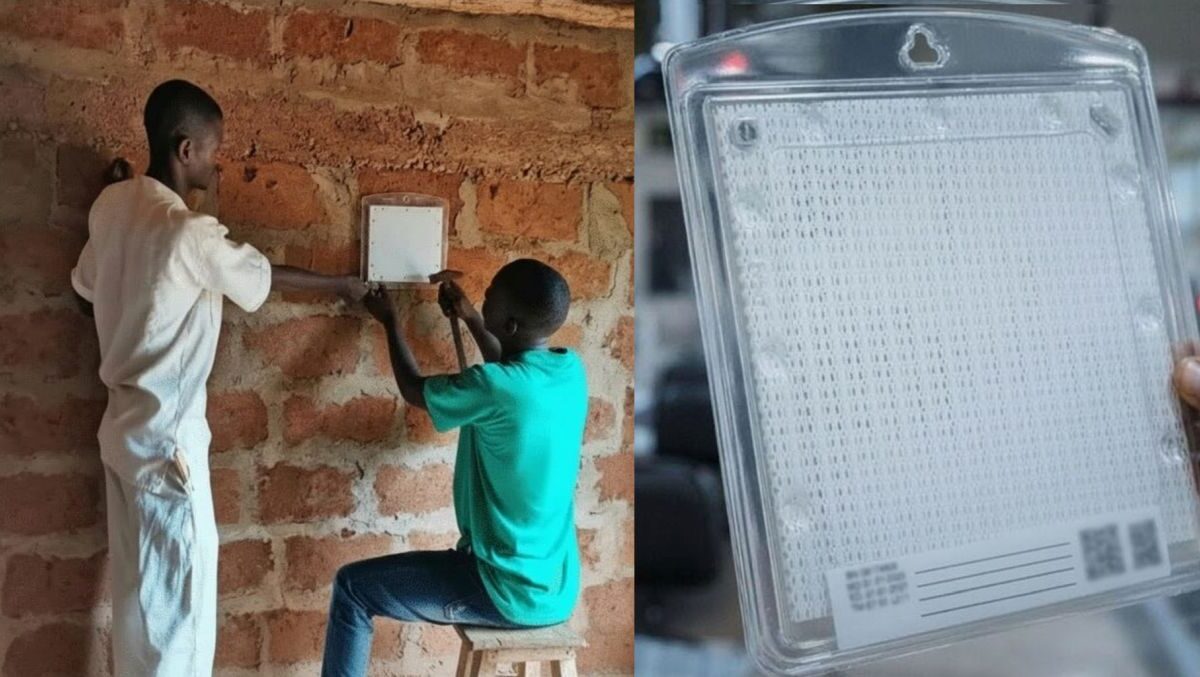
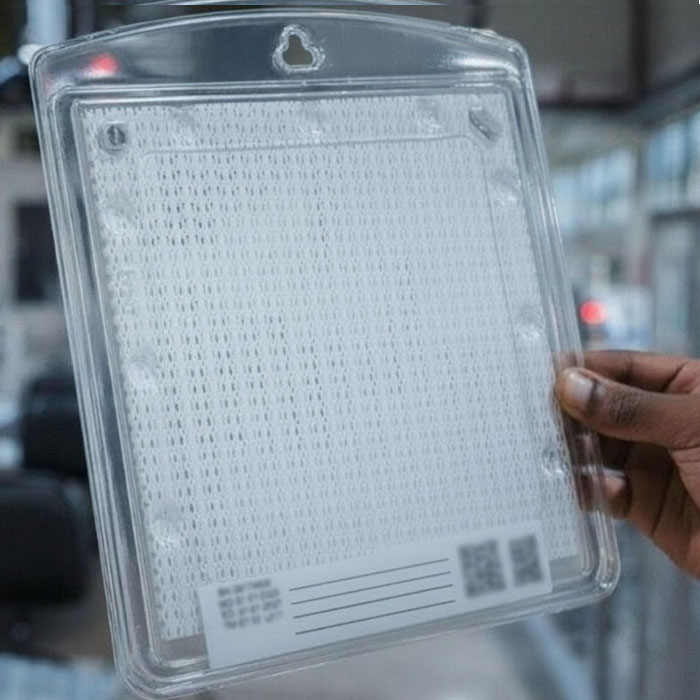
Spatial emanators, also known as spatial repellents, are a new class of vector control intervention designed to complement insecticide-treated mosquito nets or indoor residual spraying and protect people from malaria and other mosquito-borne diseases. There is also hope that spatial emanators could provide protection when deployed on their own or in settings where coverage with other vector control interventions is low.
Made of a thin sheet of plastic or mesh on a frame smaller than a standard sheet of paper, they hang on the wall or from the ceiling and slowly release active ingredients into the air. These chemicals repel mosquitoes from entering a treated space and disrupt their ability to locate and bite human hosts.
Insecticide-treated nets are by far the most widely used vector control intervention but resistance to the key insecticide used on them – pyrethroids – has impacted their efficacy. As nets are used in close contact with people and over many years, the choice of safe and sufficiently durable insecticides is extremely limited. Developing new insecticides to keep ahead of resistance has proven to be a costly, complex and lengthy process. Additionally, mosquitoes have adapted to wide-scale net use, with more biting happening earlier in the evening when a person may not be sleeping under a net.
Indoor residual spraying can be logistically challenging, particularly in remote areas, and reaching the required coverage rates over successive spray rounds may be challenging due to household refusal.
Vectorcontrolintervention
Insecticide-treated nets are by far the most widely used vector control intervention but resistance to the key insecticide used on them – pyrethroids – has impacted their efficacy. As nets are used in close contact with people and over many years, the choice of safe and sufficiently durable insecticides is extremely limited. Developing new insecticides to keep ahead of resistance has proven to be a costly, complex and lengthy process. Additionally, mosquitoes have adapted to wide-scale net use, with more biting happening earlier in the evening when a person may not be sleeping under a net.
Indoor residual spraying can be logistically challenging, particularly in remote areas, and reaching the required coverage rates over successive spray rounds may be challenging due to household refusal.
Why Spatial Emanators
Spatial emanators, which are compact and easier to transport than nets or spray equipment, could be a cost-effective complementary, or even alternative, intervention. They may prove effective in settings where deploying nets or sprays is challenging, such as in humanitarian crises where there may not be structures to spray or hang nets, or in settings such as urban environments where the uptake of conventional vector control interventions has been low. Because spatial emanators provide around-the-clock indoor protection, they are also likely to protect people from mosquitoes that primarily bite during the day, such as the Aedes mosquito, which transmits dengue and other viruses like yellow fever, zika and chikungunya.
Spatial emanators have shown promising results in reducing mosquito bites and malaria transmission when used in combination with mosquito nets. A Unitaid-funded trial in Kenya was the first to show the significant impact of spatial emanators against malaria, reducing infections by one-third. Additional Unitaid-backed research trials in Mali and Sri Lanka have investigated the intervention’s efficacy against malaria and dengue, respectively. This work builds on previous trials: one in Indonesia that suggested a positive impact on malaria and another in Peru that found that spatial repellents reduced the risk of dengue infection by 34%. A recent systematic review concluded that spatial emanators are effective at reducing malaria cases and such protective effect is highly dependent on high community coverage.